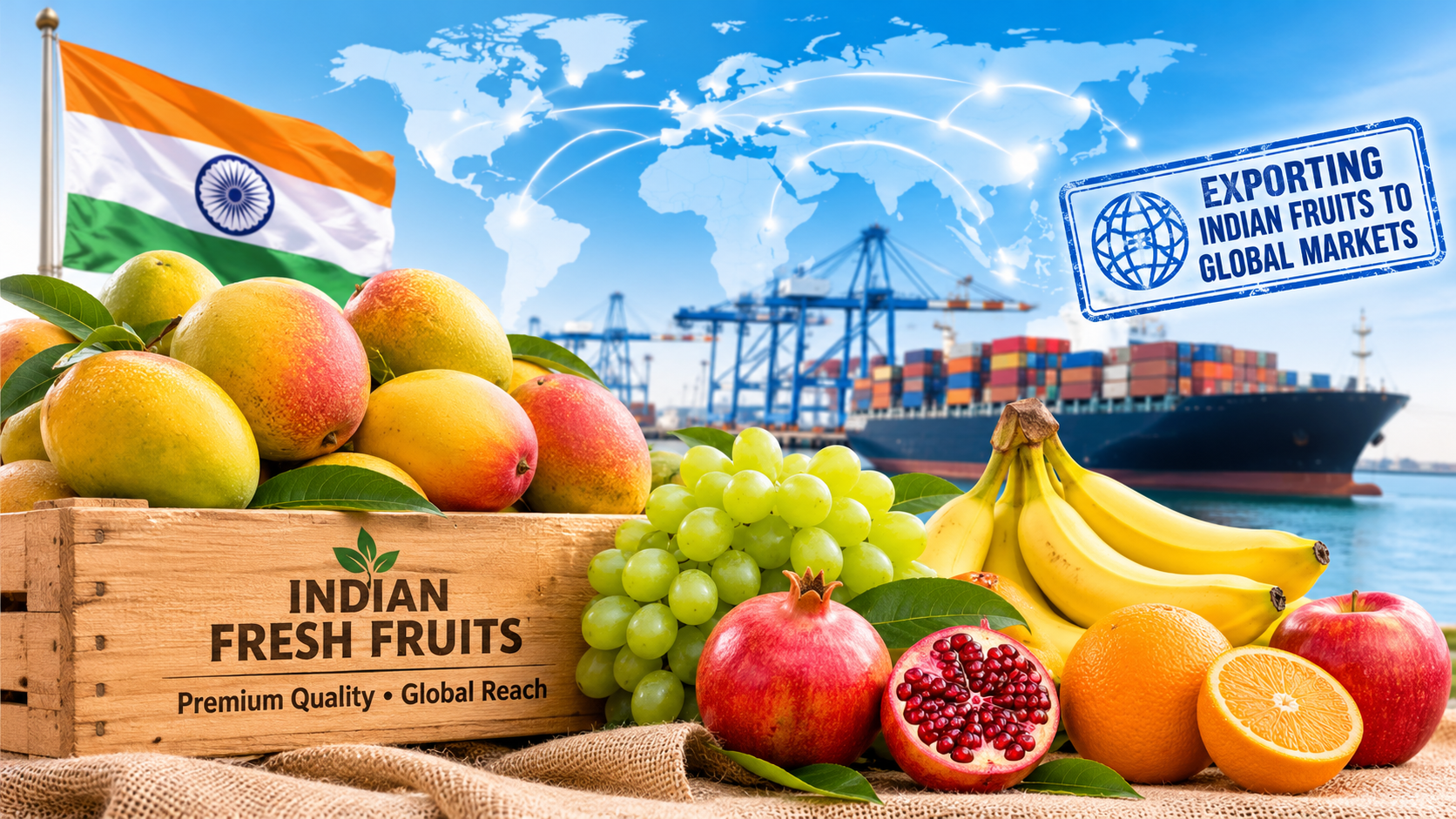
India is known for its diverse fruit production, offering international buyers access to a wide range of fresh and seasonal produce. From the sweetness of Indian mangoes to the freshness of grapes, pomegranates, bananas and citrus fruits, Indian fruit varieties serve different consumer preferences and market requirements across the world.
However, exporting fresh fruits is more than simply sourcing produce and shipping it overseas. Fresh fruits are perishable products that require careful selection, grading, packaging, temperature management, documentation and coordination throughout the supply chain. Even a small delay or unsuitable storage condition can affect freshness, shelf life and product quality.
For international buyers, understanding how Indian fresh fruits move from farms to overseas markets can make sourcing decisions easier and more reliable. This guide explains the major fruit varieties available in India, important quality considerations, export preparation, packaging methods, logistics and the factors buyers should evaluate before placing an order.
Executive Key Takeaways
- Fruit Variety: International buyers can source Indian mangoes, grapes, pomegranates, bananas, citrus fruits, guavas and papayas, subject to seasonal availability and market requirements.
- Quality and Compliance: Buyers should confirm fruit grade, maturity, physical condition, pesticide residue compliance and traceability requirements before shipment.
- Export Preparation: The process may include sourcing, harvesting, inspection, grading, post-harvest handling, testing, certification, packaging and customs procedures.
- Packaging and Logistics: Suitable cartons, ventilation, protective trays, temperature management and a suitable air or sea freight plan help protect perishable produce.
- Buyer Due Diligence: Buyers should evaluate an exporter's product knowledge, quality specifications, documentation awareness, packaging arrangements, logistics coordination and communication.
Why Is India an Important Source of Fresh Fruits?
India has a varied climate, fertile agricultural regions and multiple growing seasons. These conditions support the production of several tropical, subtropical and temperate fruits.
Different regions specialise in different varieties. This gives international buyers opportunities to source fruits according to seasonal availability, taste preferences, quality specifications and destination-market demand.
Some important advantages of sourcing fresh fruits from India include:
The suitability of a fruit for a particular market depends on its variety, harvest season, quality, shelf life, import regulations and transportation arrangements.
Which Fresh Fruits Can International Buyers Source from India?
India produces a wide range of fruits for domestic consumption and international trade. The following are some important categories that overseas importers may consider.
1. Indian Mangoes
Mangoes are among India's best-known tropical fruits. Their flavour, aroma, texture and variety make them popular with consumers in many international markets.
Popular Indian mango varieties include:
Each variety has different characteristics in terms of sweetness, fibre content, colour, size and maturity period. Buyers should select varieties according to their target consumers and destination-market requirements.
For export orders, important considerations include maturity level, fruit size, appearance, handling, treatment requirements where applicable and suitable packaging.
2. Fresh Grapes
Indian grapes are sourced by international buyers for retail distribution, wholesale markets and food businesses.
The major considerations when purchasing grapes include:
Grapes are sensitive to handling and storage conditions. Appropriate pre-cooling, packaging and cold-chain arrangements help maintain their quality during transportation.
3. Pomegranates
Pomegranates are valued for their attractive appearance, edible arils and versatility in fresh-food markets.
Buyers may evaluate pomegranates based on:
Careful sorting and packaging help reduce physical damage during handling and transportation.
4. Bananas
Bananas are widely consumed and are suitable for different retail and wholesale distribution channels.
Export buyers should pay attention to maturity, uniformity, size, bunch condition and post-harvest handling. The fruit is generally transported at a controlled maturity stage so that ripening can be managed according to the destination and distribution plan.
Temperature requirements should be selected carefully because unsuitable conditions can affect banana quality.
5. Citrus Fruits
Citrus fruits include oranges, mandarins, lemons and other varieties. They are used for fresh consumption, juice preparation and food-service applications.
Important quality factors include:
Buyers should specify the variety and grade required before confirming an order.
6. Guava and Papaya
Guava and papaya are also important tropical fruit categories that buyers may explore.
Guavas are valued for their flavour, aroma and nutritional profile, while papayas are commonly used in fresh-food retail, food service and processing applications.
Since both are perishable, careful harvesting, sorting, packaging and transportation planning are important.
What Quality Standards Should Buyers Check Before Importing Indian Fruits?
Quality is one of the most important factors in fresh fruit sourcing. A product that looks good at the time of dispatch must also remain suitable for sale when it reaches the destination market.
International buyers should communicate their specifications clearly before confirming an order.
1. Fruit Size and Grade
Fruit grading helps maintain consistency within a shipment. Buyers may specify size ranges, weight categories, visual appearance and acceptable variations.
For example, a supermarket buyer may require uniform fruit sizes for retail display, while a wholesale buyer may have different grading preferences.
2. Maturity and Ripeness
Fruits should be harvested at a maturity stage appropriate for their variety, journey duration and intended use.
Harvesting too early or too late may affect taste, texture, ripening behaviour and shelf life. The correct maturity stage should be agreed upon before procurement.
3. Physical Condition
Fruits should be checked for visible defects such as:
The acceptable defect level should be defined in the purchase specifications.
4. Pesticide Residue Compliance
Importing countries may have specific maximum residue limits (MRLs) for pesticides and other agricultural chemicals.
Buyers should confirm that the produce and its supporting test documentation meet the applicable requirements of the destination country. Compliance in one market should not automatically be assumed to meet the requirements of another.
5. Traceability
Traceability helps identify the origin and movement of produce through the supply chain.
Depending on the fruit, destination market and applicable export protocol, records may include farm details, batch or lot information, laboratory results, packing information and consignment details.
India's APEDA HortiNet system supports traceability and certification processes for notified horticultural products. The applicable process varies by product and market.
How Does the Fresh Fruit Export Process Work in India?
Exporting fresh fruits involves several stages. Proper coordination between growers, suppliers, packhouses, laboratories, exporters, logistics partners and relevant authorities helps prepare the shipment for international transportation.
Step 1: Understanding the Buyer's Requirements
The process begins with understanding the importer's requirements.
Before sourcing produce, the buyer and exporter should discuss:
Clear specifications help reduce misunderstandings during procurement and inspection.
Step 2: Sourcing from Suitable Farms and Suppliers
After confirming the requirements, the exporter identifies suitable growers or suppliers.
The sourcing decision should consider fruit variety, growing region, harvest period, quality history, availability and traceability requirements.
For products and destinations covered by specific export protocols, farm registration and other prescribed procedures may apply.
Step 3: Harvesting and Initial Inspection
Harvesting must be planned according to the fruit's maturity and handling requirements.
The produce is inspected for visible defects, damage, maturity and general condition. Damaged or unsuitable fruits are separated before further processing.
For perishable fruits, reducing the time between harvesting and appropriate post-harvest handling is important.
Step 4: Sorting and Grading
Fruits are sorted according to agreed specifications.
Grading may consider:
Consistent grading helps buyers receive produce that meets their intended retail, wholesale or processing requirements.
Step 5: Cleaning and Post-Harvest Handling
Depending on the fruit and export protocol, post-harvest handling may include cleaning, washing, drying, treatment or other approved processes.
The process must be appropriate for the specific fruit and destination market. Not every fruit follows the same treatment procedure.
Step 6: Laboratory Testing and Certification
Some fruits and destination markets require specific testing, inspection, certification and traceability procedures.
These may include pesticide residue analysis, phytosanitary inspection and other applicable quality or food-safety requirements.
A phytosanitary certificate is issued by the authorised plant quarantine authority when the relevant requirements are met. Additional declarations or treatments may be necessary depending on the importing country's rules.
Step 7: Export Packaging and Labelling
Once the produce meets the agreed specifications and applicable requirements, it is packed for transportation.
Packaging should protect the fruit from impact, compression, moisture-related problems and unnecessary movement.
Labels and shipping marks should follow buyer instructions and applicable destination-country requirements.
Step 8: Cold Storage and Transportation Planning
Temperature management is essential for many fresh fruits.
The suitable temperature and humidity depend on the fruit, variety, maturity, treatment and expected journey duration. Different fruits should not automatically be stored under identical conditions.
Before dispatch, the exporter and logistics team should plan the transportation mode, route, transit time, handling arrangements and destination delivery requirements.
Step 9: Customs Clearance and Shipment Dispatch
The export documentation and customs formalities are completed according to the applicable regulations.
Once the shipment is cleared and released for dispatch, it moves through the selected transportation network.
The buyer should receive relevant shipment and document updates to support import clearance and arrival planning.
What Documents Are Required for Fresh Fruit Exports from India?
The exact documents depend on the fruit, destination country, buyer's contract, transportation mode and applicable regulations.
Commonly relevant documents may include:
Not every shipment requires every document. Exporters should verify the current requirements for the specific product and destination before dispatch.
How Is Fresh Fruit Packaging Managed for International Shipping?
Packaging plays an important role in protecting fresh fruits during storage, loading, transportation and distribution.
The packaging format should be selected according to the fruit's physical characteristics, shelf-life requirements, transportation method and buyer's preferences.
Corrugated Fibreboard Cartons
Corrugated cartons are commonly used for many fresh fruit categories. They provide a practical outer packaging option and can be designed according to fruit size, weight and ventilation requirements.
Ventilated Packaging
Ventilation openings may support airflow around the produce when the packaging design and cooling arrangement are suitable.
The number, size and position of openings should be selected according to the fruit and packing configuration.
Protective Dividers and Trays
Some fruits require individual protection or separation to reduce bruising and movement inside the carton.
Trays, inserts and dividers can help maintain product arrangement during transportation.
Labelling and Identification
Packaging labels may include product details, variety, grade, net weight, country of origin, exporter information, batch identification and other required information.
The final label format should comply with the buyer's instructions and destination-market regulations.
Air Freight vs Sea Freight: Which Is Better for Fresh Fruit Exports?
The choice between air freight and sea freight depends on the fruit, shipment size, required delivery time, shelf life and overall landed cost.
Air Freight
Air freight is generally considered when speed is a priority or when the fruit has a limited transportation window.
Potential advantages include:
However, air freight may involve higher transportation costs and cargo capacity limitations.
Sea Freight
Sea freight can be suitable for larger shipments and fruits that can maintain acceptable quality under an appropriate storage and transit arrangement.
Potential advantages include:
Sea freight requires careful planning because transit duration, port handling and temperature conditions can influence product quality.
The most suitable mode should be selected after reviewing the fruit's storage requirements and the complete route.
Common Challenges in Fresh Fruit Exporting
Fresh fruit exporters and importers must manage several challenges to protect product quality and avoid unnecessary delays.
1. Short Shelf Life
Many fresh fruits have limited shelf lives. Delays during harvesting, packing, customs clearance or transportation can affect their condition.
2. Temperature Fluctuations
Incorrect temperature settings or interruptions in the cold chain can lead to premature ripening, chilling injury or quality deterioration.
3. Destination-Country Regulations
Import regulations can vary by country and product. Missing declarations, unsuitable treatment or non-compliant residue levels may result in shipment delays or rejection.
4. Physical Damage During Handling
Rough handling, overfilled cartons, unsuitable stacking and excessive movement can cause bruising.
5. Seasonal Availability
Fruit availability changes according to growing regions, harvest periods and weather conditions.
How Should International Buyers Select a Fresh Fruit Exporter in India?
Choosing a suitable exporter is an important part of building a reliable sourcing relationship.
Buyers should evaluate the following factors before finalising a supplier.
International buyers looking to explore sourcing opportunities can connect with a suitableFresh Fruits Exporter in India to discuss fruit varieties, availability, packaging requirements and export arrangements.
Why Is Export Logistics Important for Fresh Fruit Shipments?
Fresh fruit exports involve more than moving cartons from one location to another. The supply chain must protect the produce while coordinating different activities and stakeholders.
An effective logistics plan considers:
A well-planned shipment helps reduce avoidable handling delays and supports better product-condition management.
For buyers, discussing logistics requirements before confirming an order is especially important for perishable products. The exporter and logistics team should align the shipping schedule with the fruit's expected shelf life and destination requirements.
Conclusion
India offers international buyers a broad selection of fresh fruits, supported by diverse agricultural regions and established sourcing networks. However, successful fresh fruit exports depend on much more than product availability.
Quality selection, correct maturity, grading, residue compliance, traceability, packaging, temperature management and destination-specific documentation all play an important role in preparing a shipment for international markets.
Buyers who define their requirements clearly and work with an exporter familiar with fresh produce handling can make better sourcing and shipment decisions.
Transtake Global provides an opportunity for international buyers to discuss fresh fruit sourcing and export requirements from India. To explore available products and discuss your business requirements, visit theFresh Fruits Exporter India service page and connect with the team.